But I'm still not in the habit of putting semicolons after everything. Despite studying Java and Scheme in high school, I never got very good with them or did anything practical. Right now, I'd say my native tongue is Python. Maybe if I get into automation, one of these days I'll
Monday, October 18, 2010
Chasing down particles
I'm up late writing MATLAB code to analyze a whole load of particle tracking data. It's not exactly a fun process, but I can feel myself getting better at MATLAB. It's like the coding equivalent of eating all my asparagus. There are some great tricks you can do to slice and dice arrays with fancy indexing. But, ugh, the syntax for optional arguments makes me wince (and avoid using optional arguments, unfortunately).
But I'm still not in the habit of putting semicolons after everything. Despite studying Java and Scheme in high school, I never got very good with them or did anything practical. Right now, I'd say my native tongue is Python. Maybe if I get into automation, one of these days I'llclamber up on the big-programmer potty learn C/C++.
But I'm still not in the habit of putting semicolons after everything. Despite studying Java and Scheme in high school, I never got very good with them or did anything practical. Right now, I'd say my native tongue is Python. Maybe if I get into automation, one of these days I'll


Monday, October 11, 2010
Storycest Is Best
For my folk song class, I'm writing an analysis of the old Scottish ballad Kemp Owyne (specifically the version called Kempion; here are some related ballads*). The most interesting part, I find, is looking at the relationships between the different versions and between Kemp Owyne and other stories.
Discovery number one: no version of Kemp Owyne is 'complete' in the sense of containing all the plot elements found in any version of Kemp Owyne. Furthermore, the different versions ('subspecies'?) seem to differ not randomly but systematically in the elements they omit. The Kempion version leaves out the vast majority of the beginning, so for example, you never find out why the evil stepmother curses the princess (in fact, you don't even find out it was the evil stepmother's fault until the very end), whereas other versions start out with a thread where the stepmother is angry about not being called "the fairest of them all". It's hard for me to even imagine what it's like to only know one version of the story, since I'm in the privileged position of being able to read them all and cross-reference.
Discovery number two: there's a lot more swapping of story elements than I thought -- a lot more random ligation of characters into new situations. I suppose most folktales are fanfiction of other folktales, for some sense of 'fanfiction'. For example, Kemp Owyne is supposed to be identified with Ywain/Yvain from the Arthurian legends, aka the historical Owain mab Urien (and "Kemp" means 'hero' or 'champion'). Why? No reason. He's just a convenient fictional knightly hero type. But interestingly enough, there's an invocation to St. Mungo at the end of Kempion... and yet, Yvain is also supposedly St. Mungo's father! How did that happen?? Either there is massive storycest going on, or someone chose to invoke a saint who wasn't even born yet. (You have to admit that time-traveling Scots heroes and saints would be pretty awesome.)
It really is like evolution, complete with horizontal gene transfer. But also with revival and retelling and all sorts of processes that don't have obvious biological analogues. Fascinating!
[*] Those texts have some typos in them, but I wasn't about to type all of Kemp Owyne again, and I'm really fond of that whole website because it makes up in quantity what little it lacks in quality. (The typos are few enough that I feel like only scholars really ought to care about them.)
Discovery number one: no version of Kemp Owyne is 'complete' in the sense of containing all the plot elements found in any version of Kemp Owyne. Furthermore, the different versions ('subspecies'?) seem to differ not randomly but systematically in the elements they omit. The Kempion version leaves out the vast majority of the beginning, so for example, you never find out why the evil stepmother curses the princess (in fact, you don't even find out it was the evil stepmother's fault until the very end), whereas other versions start out with a thread where the stepmother is angry about not being called "the fairest of them all". It's hard for me to even imagine what it's like to only know one version of the story, since I'm in the privileged position of being able to read them all and cross-reference.
Discovery number two: there's a lot more swapping of story elements than I thought -- a lot more random ligation of characters into new situations. I suppose most folktales are fanfiction of other folktales, for some sense of 'fanfiction'. For example, Kemp Owyne is supposed to be identified with Ywain/Yvain from the Arthurian legends, aka the historical Owain mab Urien (and "Kemp" means 'hero' or 'champion'). Why? No reason. He's just a convenient fictional knightly hero type. But interestingly enough, there's an invocation to St. Mungo at the end of Kempion... and yet, Yvain is also supposedly St. Mungo's father! How did that happen?? Either there is massive storycest going on, or someone chose to invoke a saint who wasn't even born yet. (You have to admit that time-traveling Scots heroes and saints would be pretty awesome.)
It really is like evolution, complete with horizontal gene transfer. But also with revival and retelling and all sorts of processes that don't have obvious biological analogues. Fascinating!
[*] Those texts have some typos in them, but I wasn't about to type all of Kemp Owyne again, and I'm really fond of that whole website because it makes up in quantity what little it lacks in quality. (The typos are few enough that I feel like only scholars really ought to care about them.)
Sunday, September 26, 2010
Science poetry: Heredity, Thomas Hardy
I am the family face;
Flesh perishes, I live on,
Projecting trait and trace
Through time to times anon,
And leaping from place to place
Over oblivion.
The years-heired feature that can
In curve and voice and eye
Despise the human span
Of durance -- that is I;
The eternal thing in man,
That heeds no call to die
--Thomas Hardy [source]
I like the alliterations and internal-half-rhymes in the first stanza. They remind me of what little I know about Anglo-Saxon verse. (I read Beowulf once...)
Monday, September 13, 2010

Sunday, September 5, 2010
$18 can buy a lot of fun
(My living group is doing Rush right now, which means my life is basically eaten for the next two weeks, such that I feel no shame about writing a punt-tastic post like this.)
I will just note that $18 can buy more dry ice than twenty MIT students can play around with for three hours. Try it out some time. Make sure to bring soapy water, interestingly-shaped glass vessels, small white and colored lights/LEDs, coins, spoons, and hot water.
Try putting a little water in a spoon and then resting the spoon on top of a chunk of dry ice. You can see the water freeze right before your eyes. It's pretty cool.
I will just note that $18 can buy more dry ice than twenty MIT students can play around with for three hours. Try it out some time. Make sure to bring soapy water, interestingly-shaped glass vessels, small white and colored lights/LEDs, coins, spoons, and hot water.
Try putting a little water in a spoon and then resting the spoon on top of a chunk of dry ice. You can see the water freeze right before your eyes. It's pretty cool.
Sunday, August 29, 2010
What's wrong with the cartoon eukaryotic cell? [Unusual Cells pt. 1]
I'm starting a series of posts based on a class I taught about "Unusual Cells" for Splash. Eventually, each post will include links to all the others.
The point of this series is to understand the wild and crazy unusual cells that populate the world (and that populate us!). But we should first understand the usual cell... or, perhaps, we will find that there is no such thing as a usual cell.
Consider the cartoon eukaryotic cell that we all know and, presumably, love:
 Figure 1: Typical eukaryotic cell. I'll refrain from listing the organelles, in order to prevent yawning; if you're curious, check Wikipedia, where this image is from.
So... what's wrong with this cell? Here's a sampling of some of the answers my Splash students have given me:
The answer I'm really looking for is this:
(To be fair, Splash students pretty much always get this one too, and it's a general case of the answers I gave above except for #3.)
There's nothing in this cell! Yes, the major organelles are there, but where is the cytoskeleton? It's just that tiny little fiber (#7), which you can barely even see. Real cells are just packed with stuff. Structural proteins, membrane proteins, highways of vesicles wandering to and fro...
Now, of course, this is kind of a necessary evil. We can't include all that stuff in cartoons of the cell that are supposed to show the major organelles, because it would just be a distraction. Visual noise. For example, check out this slice of a more realistic watercolor:
 Figure 2: You can see a bit of the Golgi (yellow stacks) in this picture. The geodesic-dome-looking thing is a protein framework that's making a vesicle bud out from the Golgi. [Source]
Seriously, check out the whole thing. It's beautiful. If I could get a quality print of this I would hang it above my bed. But even this is far from showing everything. The empty space between all those blobs is filled with crazy amounts of ions, small molecules, and of course water.
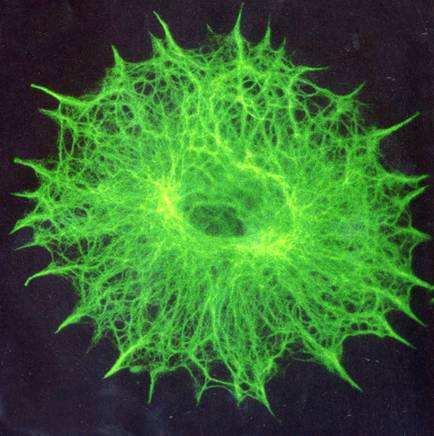
For a different perspective, check out these photos of cells in which the cytoskeleton has been labeled with green fluorescence. Yep, that's just the cytoskeleton... it reaches everywhere, helping the cell maintain its shape and move around (just like the human skeleton), and giving direction to packages of important chemicals as they motor their way hither and thither (something like the human circulatory system).


To do: find out what percentage of the membrane surface area is proteins. I know this is in one of my textbooks somewhere.
The point of this series is to understand the wild and crazy unusual cells that populate the world (and that populate us!). But we should first understand the usual cell... or, perhaps, we will find that there is no such thing as a usual cell.
Consider the cartoon eukaryotic cell that we all know and, presumably, love:
 Figure 1: Typical eukaryotic cell. I'll refrain from listing the organelles, in order to prevent yawning; if you're curious, check Wikipedia, where this image is from.
So... what's wrong with this cell? Here's a sampling of some of the answers my Splash students have given me:
- You can't see the DNA
- You can't see the proteins
- It's cut in half (yes, some of them are smartasses)
- There are no membrane proteins
The answer I'm really looking for is this:
It's empty!
(To be fair, Splash students pretty much always get this one too, and it's a general case of the answers I gave above except for #3.)
There's nothing in this cell! Yes, the major organelles are there, but where is the cytoskeleton? It's just that tiny little fiber (#7), which you can barely even see. Real cells are just packed with stuff. Structural proteins, membrane proteins, highways of vesicles wandering to and fro...
Now, of course, this is kind of a necessary evil. We can't include all that stuff in cartoons of the cell that are supposed to show the major organelles, because it would just be a distraction. Visual noise. For example, check out this slice of a more realistic watercolor:
 Figure 2: You can see a bit of the Golgi (yellow stacks) in this picture. The geodesic-dome-looking thing is a protein framework that's making a vesicle bud out from the Golgi. [Source]
Seriously, check out the whole thing. It's beautiful. If I could get a quality print of this I would hang it above my bed. But even this is far from showing everything. The empty space between all those blobs is filled with crazy amounts of ions, small molecules, and of course water.
For a different perspective, check out these photos of cells in which the cytoskeleton has been labeled with green fluorescence. Yep, that's just the cytoskeleton... it reaches everywhere, helping the cell maintain its shape and move around (just like the human skeleton), and giving direction to packages of important chemicals as they motor their way hither and thither (something like the human circulatory system).

To do: find out what percentage of the membrane surface area is proteins. I know this is in one of my textbooks somewhere.
Monday, August 23, 2010
Perhaps I should flip a coin?
I'm working out my class schedule for the upcoming semester, and I've run into a bit of a dilemma. Two classes are at the exact same time. Both clamor for my attention. Both are only offered in the fall, and this is my last year. They are as mutually exclusive as it is possible for two classes to be.
THE CANDIDATES
THE ARGUMENT
I want to study systems biology in grad school. Therefore, I should get started. Taking this class may help me with my continuing work in the Silver lab, and might even help me get into a good grad program.
THE COUNTERARGUMENT
I will have plenty of time to study systems biology in grad school. (And if I really get an itch, I can always pick up Uri Alon's book.) I should take this chance to explore a humanities topic that I'm really interested in, while I'm still an undergrad, because time is short.
------------------------------------------
So, what do I do? Both of these arguments are fairly convincing to me. Which one wins? Or, are there other arguments I've missed?
THE CANDIDATES
- 7.32 Systems Biology: This field is a sister to synthetic biology. I'm interested in to the point of wanting to pursue it in grad school. The Silver lab, where I'm working, is a systems biology lab in more than just name (although it's certainly not typical, being focused on engineering). Networks! Switches! Stochastic behavior! Dynamics! Oscillators! Pattern formation!
- 21A.212 Myth, Religion, and Symbolism: This class looks like it's going to hit one of my biggest avocational buttons. Despite being atheist/agnostic/nonreligious (damn labels), I've always had a fascination with the power of ritual and storytelling -- the roles they play in our lives and how they adapt to non-religious contexts. How did I manage to not notice this class existed before?
THE ARGUMENT
I want to study systems biology in grad school. Therefore, I should get started. Taking this class may help me with my continuing work in the Silver lab, and might even help me get into a good grad program.
THE COUNTERARGUMENT
I will have plenty of time to study systems biology in grad school. (And if I really get an itch, I can always pick up Uri Alon's book.) I should take this chance to explore a humanities topic that I'm really interested in, while I'm still an undergrad, because time is short.
------------------------------------------
So, what do I do? Both of these arguments are fairly convincing to me. Which one wins? Or, are there other arguments I've missed?
Sunday, August 22, 2010
Open thread: ask me questions!
Dear all the CS people who I know glance at this blog: I would love to hear from you! (And, y'know, from anyone else who happens not to study CS.)
I've recently come up short on blog topics, but also had a hankering to explain basic biology items in a way that makes them exciting to people who "hate biology", or are at best indifferent to it.
What would you like to hear about? Is there some old question left over from your intro biology course, to which you've never heard a satisfactory answer? Want quick summaries of recent developments in synthetic biology, or the ways in which biology imitates EE/CS? How about Anthropomorphized Enzyme Comics? Or, perhaps, White Lies Your High School Bio Teacher Told You?
Reply now and you might even get the post before Monday morning! :D
I've recently come up short on blog topics, but also had a hankering to explain basic biology items in a way that makes them exciting to people who "hate biology", or are at best indifferent to it.
What would you like to hear about? Is there some old question left over from your intro biology course, to which you've never heard a satisfactory answer? Want quick summaries of recent developments in synthetic biology, or the ways in which biology imitates EE/CS? How about Anthropomorphized Enzyme Comics? Or, perhaps, White Lies Your High School Bio Teacher Told You?
Reply now and you might even get the post before Monday morning! :D
Sunday, August 15, 2010
Science Poetry: The Perfume, A. D. Hope
I ran across this gem while trolling randomly through the archives of The Wondering Minstrels. It's the newest incarnation of the archives of an old mailing list, long gone out of service, but at least all the poems and commentary are still there. I'm in the process of going through all the poems, starting from no. 1. It's a wonderful archive, and I highly recommend spending some time there.
 Figure 1: Bombykol, from Wikipedia. "Doesn't that structure make you simply wild with desire?"
I remember hearing stories about this compound, or one very like it, in my organic chemistry class. Apparently, whenever someone wanted to deliver a vial of it across campus, they would be pursued by a gradually accumulating swarm of moths. I like to play that scene in my head. "I'm a synthetic chemist -- I did not sign up for entomological fieldwork!! *panicked fleeing across campus*"
"... marked males of the silkworm moth have been known to fly upwind seven miles to a fragrant female of their kind ... the chemical compound with which a female silkworm moth attracts mates is highly specific; no other species seem aware of it. In 1959, the Nobel Laureate Adolph Butenandt of the Max Planck Institute for Biochemistry in Munich succeeded in analysing it. He found it to be an alcohol with sixteen carbon atoms per molecule...."
L. and M. Milne: The Senses of Animals and Men.
0 Chloë, have you heard it,
This news I sing to you?
It's true, my lovely bird, it
Is absolutely true!
A biochemist probing
Has caught without a doubt
The Queen of Love disrobing
And found her secret out.
What drives the Bombyx mori
To fly, intrepid male,
Lured by the old, old story
Six miles against the gale?
The formula, my Honey,
Is now in print to prove
What is, and no baloney,
The very stuff of love.
At Munich on the Isar
Those molecules were found
Which everyone agrees are
What makes the world go round;
What draws the male creation
To love, my darling doll,
Turns out, on trituration,
To be an alcohol.
A Nobel Laureatus
Called Adolph Butenandt
Contrived to isolate us
This strong intoxicant.
The boys are celebrating
And singing at the club:
Here's Bottoms up! to mating,
Since Venus keeps a pub!
My angel, 0, my angel,
What is it you suffuse,
What redolent evangel,
What nosegay of good news?
What draws me like a dragnet
And holds and keeps me tight?
What odds! my fragrant magnet,
I shall be drunk tonight!
-- A. D. Hope [source]
 Figure 1: Bombykol, from Wikipedia. "Doesn't that structure make you simply wild with desire?"
I remember hearing stories about this compound, or one very like it, in my organic chemistry class. Apparently, whenever someone wanted to deliver a vial of it across campus, they would be pursued by a gradually accumulating swarm of moths. I like to play that scene in my head. "I'm a synthetic chemist -- I did not sign up for entomological fieldwork!! *panicked fleeing across campus*"
Monday, August 9, 2010
Even supervillains have work-life balance problems
I just got back from seeing Despicable Me with my brother. Although this is not a Pixar movie, it follows Pixar's pattern by being about far, far more than the trailer lets on. (I remember being distinctly unimpressed by the WALL-E trailer, and then I cried my eyes out through the whole thing.) The plot is really fun, and the 3-D is unobtrusive enough to be mostly inconsequential.*
I thought it was pretty cool to see a supervillain (and an older, male supervillain at that) deal with the sort of struggles and discrimination normally associated with working mothers. I haven't experienced these struggles first-hand, of course, but a number of scenes reminded me very strongly of things I'd read -- especially Dr. Isis' blog posts and Allison Pearson's book I Don't Know How She Does It. Seeing parent-discrimination divorced from sexism was quite strange; but then again, I don't doubt that there are fathers in the world who have suffered career setbacks and discrimination because of family demands.
The end of the movie leaves open whether the main character continues the same level of career activity (in the same or a different field), or scales back in order to spend more time with the children. I would have liked to see something indicating that he achieved a productive balance; maybe a montage of newspaper headlines showing him up to something resembling his old tricks, perhaps with the children's collaboration.
Also, as a side note, whoever was writing Margo (the oldest girl) has done their homework on sibling-order effects on personality. I'm an oldest daughter, and though of course I'm not exactly like Margo I found myself identifying with her much more strongly than I was expecting to. (The girls in the movie are not biological siblings. Anyone know if sibling-order effects also happen in families brought together by adoption? It seems plausible -- these effects ought to be mediated in large part by environment... but I'm rambling now, because it's late.)
Go see Despicable Me if you're up for some funny, frivolous action, and so much cuteness that all your teeth will dissolve.
* I'm still cheesed at being made to pay an extra $4 for an effect that, IMO, adds very little to a movie animated in Pixar's style. But there's a cute bit in the credits where some minor characters play around with it, so stick around.
I thought it was pretty cool to see a supervillain (and an older, male supervillain at that) deal with the sort of struggles and discrimination normally associated with working mothers. I haven't experienced these struggles first-hand, of course, but a number of scenes reminded me very strongly of things I'd read -- especially Dr. Isis' blog posts and Allison Pearson's book I Don't Know How She Does It. Seeing parent-discrimination divorced from sexism was quite strange; but then again, I don't doubt that there are fathers in the world who have suffered career setbacks and discrimination because of family demands.
The end of the movie leaves open whether the main character continues the same level of career activity (in the same or a different field), or scales back in order to spend more time with the children. I would have liked to see something indicating that he achieved a productive balance; maybe a montage of newspaper headlines showing him up to something resembling his old tricks, perhaps with the children's collaboration.
Also, as a side note, whoever was writing Margo (the oldest girl) has done their homework on sibling-order effects on personality. I'm an oldest daughter, and though of course I'm not exactly like Margo I found myself identifying with her much more strongly than I was expecting to. (The girls in the movie are not biological siblings. Anyone know if sibling-order effects also happen in families brought together by adoption? It seems plausible -- these effects ought to be mediated in large part by environment... but I'm rambling now, because it's late.)
Go see Despicable Me if you're up for some funny, frivolous action, and so much cuteness that all your teeth will dissolve.
* I'm still cheesed at being made to pay an extra $4 for an effect that, IMO, adds very little to a movie animated in Pixar's style. But there's a cute bit in the credits where some minor characters play around with it, so stick around.
Wednesday, August 4, 2010
Gunnerkrigg Court takes on animal research ethics
I think I chose a particularly fortuitous time to highlight Gunnerkrigg Court, because it's just started taking on one of my favorite themes, and I think it's being handled very well so far.
First, read the last two pages of the comic: one, two. You don't need much context to see what I'm talking about.
 Figure 1: Rock on, Paz.
Now, if I remember correctly, Paz is a character we haven't seen much of yet (her first appearance is basically as an extra), and I'm looking forward to seeing her developed in more detail. I'm very glad to see she's taking (or at least professing) a sensitive, ethical attitude toward animal research. Realistic, too -- I'd swear that Tom Siddell has read the NIH Guidelines. I admire the fact that Paz aspires to reduce or even eliminate the use of animals in her research. Per fantasy conventions, all of these girls are stunningly mature and knowledgeable compared to the average high schooler, but I'm still very impressed by her attitudes and opinions.
(Plus, I'm pleased that she's apparently not white and not a native English speaker. I'm not terribly well informed about racial/identity politics, but nothing about the way she's portrayed jumps out at me as being problematic.)
I will be very interested to see how this plays out. In particular:
I have faith that all of these questions will be answered, if not in as much detail as I would like. Gunnerkrigg Court wouldn't just introduce a subplot like this without exploring it in quite a bit of detail.
First, read the last two pages of the comic: one, two. You don't need much context to see what I'm talking about.
 Figure 1: Rock on, Paz.
Now, if I remember correctly, Paz is a character we haven't seen much of yet (her first appearance is basically as an extra), and I'm looking forward to seeing her developed in more detail. I'm very glad to see she's taking (or at least professing) a sensitive, ethical attitude toward animal research. Realistic, too -- I'd swear that Tom Siddell has read the NIH Guidelines. I admire the fact that Paz aspires to reduce or even eliminate the use of animals in her research. Per fantasy conventions, all of these girls are stunningly mature and knowledgeable compared to the average high schooler, but I'm still very impressed by her attitudes and opinions.
(Plus, I'm pleased that she's apparently not white and not a native English speaker. I'm not terribly well informed about racial/identity politics, but nothing about the way she's portrayed jumps out at me as being problematic.)
I will be very interested to see how this plays out. In particular:
- How will the teachers and other students at the Court react to the presence of animal research at their school? Will they even find out, or do they maybe know already? Will we see a range of attitudes, from "Animal welfare is not that important" to "All animal research is morally reprehensible"?
- How will the supernatural entities in the forest react? Will their reaction be shaped more by opposition to the Court in general, or by the fact that many of them are (at least in some sense) animals themselves?
- What is Paz doing, and who is she working with? How did she come by her research assistantship? Is she doing largely self-directed work or is she being used as a pawn by some unscrupulous adults? Is she aware of the broader implications of her work, whatever those turn out to be?
- Is this research actually justifiable/ethical or not? Right now all we have is Paz's word, and we have very little idea what they're actually studying.
I have faith that all of these questions will be answered, if not in as much detail as I would like. Gunnerkrigg Court wouldn't just introduce a subplot like this without exploring it in quite a bit of detail.
Friday, July 30, 2010
Watch out for the mad biologist!
One of my favorite webcomics is Gunnerkrigg Court. It's a mixed fantasy, SF, and school story with some characters who are pretty badass for their apparent age (middle/high school). Antimony and Kat, the two main characters, play a crucial, growing role in trying to preserve peace and increase cooperation between their school (the Court) and the adjacent forest -- but they're also just two girls capering in a world that's often a lot bigger than they realize. It's framed as technology versus magic/divinity, but I have a feeling it runs a lot deeper than that.
I highly recommend reading it, even though it starts out just a little slow -- the 'real' threads start soon enough.
But why am I highlighting it now? I'm super excited, because in among all the magicians and mad roboticists, I think we may have our first mad biologist character.
Should I say that again? Mad. Biologist. Character.
Squee!
Err, I would totally include a small click-to-embiggen preview image of the comic, but I can't figure out how to make Blogger do that. I have been thinking of migrating to Wordpress...
I highly recommend reading it, even though it starts out just a little slow -- the 'real' threads start soon enough.
But why am I highlighting it now? I'm super excited, because in among all the magicians and mad roboticists, I think we may have our first mad biologist character.
Should I say that again? Mad. Biologist. Character.
Squee!
Err, I would totally include a small click-to-embiggen preview image of the comic, but I can't figure out how to make Blogger do that. I have been thinking of migrating to Wordpress...
Monday, July 19, 2010
But why is the sky blue?
Here's a sampling of the random questions I've encountered in the past week that have piqued my interest. I feel like these should be answerable with a little effort (by someone other than me, since my brain is stuck in corners), but they're also fun to just speculate about.
It's a commonplace that Benadryl makes you drowsy. kcr noted that it only seems to make him drowsy when it isn't busy fighting off an actual allergic reaction. Are the antihistamine and sleep-inducing activities of Benadryl different? Does one compete with the other?
Why do martial arts seem to be optimized for fighting other practitioners of that same martial art? I don't know anything about how martial arts develop, but my intuition says something like this: it's dangerous and impractical to always practice by getting in real fights, and if you're going to make a new variant on an existing style, then practicing against others of that style is a decent proxy for being in real fights. Of course, this runs into the bootstrapping problem of where did the first formalized martial art come from... but humans have been punching each other for so many years that I feel like basic instinct can serve as a starting point. (How do you go about designing a martial art for "real combat"? I know these exist -- mumble military mumble something.)
What's the most cost-effective way to make ice cream using a dry ice and ethanol bath?
It's a commonplace that Benadryl makes you drowsy. kcr noted that it only seems to make him drowsy when it isn't busy fighting off an actual allergic reaction. Are the antihistamine and sleep-inducing activities of Benadryl different? Does one compete with the other?
Why do martial arts seem to be optimized for fighting other practitioners of that same martial art? I don't know anything about how martial arts develop, but my intuition says something like this: it's dangerous and impractical to always practice by getting in real fights, and if you're going to make a new variant on an existing style, then practicing against others of that style is a decent proxy for being in real fights. Of course, this runs into the bootstrapping problem of where did the first formalized martial art come from... but humans have been punching each other for so many years that I feel like basic instinct can serve as a starting point. (How do you go about designing a martial art for "real combat"? I know these exist -- mumble military mumble something.)
What's the most cost-effective way to make ice cream using a dry ice and ethanol bath?
Monday, July 12, 2010
A sure sign of a healthy lab
Whiteboard, day 1:
Whiteboard, day 2:
Paper attached to whiteboard, day 3:
Oh Danny boy, pipets, pipets are calling,
From bench to bench, and in the TC hood.
The gels are gone, and all the yields are falling;
'Tis you, 'tis you must make the data good.
So come ye back, where we cells are abiding,
Or when the lab is lonely as the grave.
'Tis here we'll be, in log-phase swift dividing...
...if you will please not put us in the autoclave!
THURS 3:30
GROUP MEETING
DANNY
GROUP MEETING
DANNY
Whiteboard, day 2:
THURS 3:30
GROUP MEETING
Oh DANNY boy
GROUP MEETING
Oh DANNY boy
Paper attached to whiteboard, day 3:
Oh Danny boy, pipets, pipets are calling,
From bench to bench, and in the TC hood.
The gels are gone, and all the yields are falling;
'Tis you, 'tis you must make the data good.
So come ye back, where we cells are abiding,
Or when the lab is lonely as the grave.
'Tis here we'll be, in log-phase swift dividing...
...if you will please not put us in the autoclave!
Friday, July 2, 2010
Bacteria break symmetry too
It's amazing what you can learn on the internet, especially when looking for something totally unrelated! :)
Caulobacter crescentus is a really cool little bacterial species with a funky two-phase lifestyle. The "stalked cells" attach themselves to rocks or whatever in the freshwater environments where these guys live. When a stalked cell divides, part of it remains a stalked cell and part splits off into a "swarmer cell". The swarmer cells swim around like more 'normal' bacteria.
Check out some images of these dudes. (Blogger's image uploader is misbehaving so you guys get a link to Google Images. Sigh.)
They're a fascinating organism to study because their cell division is asymmetrical. If you think back to the high-school-biology version of mitosis... well, it seems like a totally symmetrical process, right? There would seem to be no reason for a particular set of molecules to end up in one daughter cell and not the other, because everything's floating freely around in a droplet of water anyway. But in an asymmetric division like this, the two daughter cells have to develop in different ways. The stalked cell has to keep maintaining its stalk, but the swarmer cell has to grow a flagellum and start making the necessary sensory proteins to swim toward yummy-smelling food molecules. And not only that, but there's a correct orientation for this difference and an incorrect one. It would be kind of awkward if the new stalked cell started trying to swim away, and the swarmer cell floated around trying vainly to anchor to something.
So there must be some sophisticated mechanisms at play here. Notably, it's not that the two daughter cells end up with different genes -- after all, the swarmer cell will later settle and put down roots as a stalked cell. What matters is the presence (or absence) of proteins and other molecules that regulate those genes, so the stalked cell can keep making stalk proteins while the swimmer turns those genes off and turns on the ones for making a flagellum.
This asymmetric division isn't just some strange bacterial phenomenon. Every multicellular creature goes through this kind of process as it grows from a single cell (a fertilized egg) to whatever elaborate body it has as an adult. Figuring out the origins of symmetry-breaking in cell division is one of the major problems of developmental biology.
It also has to do with stem cells, by definition. The vast majority of cells in your body are "terminally differentiated" -- that is, they've gone from nondescript round blobs to fully elaborated cells with sophisticated morphology, heavily optimized for doing whatever job it is they need to do. But the 'terminally' part means they stop dividing once they reach maturity. So if you lose some mature cells, you need to get new ones from a renewable pool of immature cells. These are stem cells. The key defining feature of a stem cell is that it can divide asymmetrically. One of its progeny will be a precursor cell, traveling inexorably down the path to neuron-hood or white-blood-cell-hood or whatever. The other will be a new stem cell, all set to keep hanging in the lazy infinite loop of waiting until it's needed again.
Caulobacter crescentus is a really cool little bacterial species with a funky two-phase lifestyle. The "stalked cells" attach themselves to rocks or whatever in the freshwater environments where these guys live. When a stalked cell divides, part of it remains a stalked cell and part splits off into a "swarmer cell". The swarmer cells swim around like more 'normal' bacteria.
Check out some images of these dudes. (Blogger's image uploader is misbehaving so you guys get a link to Google Images. Sigh.)
They're a fascinating organism to study because their cell division is asymmetrical. If you think back to the high-school-biology version of mitosis... well, it seems like a totally symmetrical process, right? There would seem to be no reason for a particular set of molecules to end up in one daughter cell and not the other, because everything's floating freely around in a droplet of water anyway. But in an asymmetric division like this, the two daughter cells have to develop in different ways. The stalked cell has to keep maintaining its stalk, but the swarmer cell has to grow a flagellum and start making the necessary sensory proteins to swim toward yummy-smelling food molecules. And not only that, but there's a correct orientation for this difference and an incorrect one. It would be kind of awkward if the new stalked cell started trying to swim away, and the swarmer cell floated around trying vainly to anchor to something.
So there must be some sophisticated mechanisms at play here. Notably, it's not that the two daughter cells end up with different genes -- after all, the swarmer cell will later settle and put down roots as a stalked cell. What matters is the presence (or absence) of proteins and other molecules that regulate those genes, so the stalked cell can keep making stalk proteins while the swimmer turns those genes off and turns on the ones for making a flagellum.
This asymmetric division isn't just some strange bacterial phenomenon. Every multicellular creature goes through this kind of process as it grows from a single cell (a fertilized egg) to whatever elaborate body it has as an adult. Figuring out the origins of symmetry-breaking in cell division is one of the major problems of developmental biology.
It also has to do with stem cells, by definition. The vast majority of cells in your body are "terminally differentiated" -- that is, they've gone from nondescript round blobs to fully elaborated cells with sophisticated morphology, heavily optimized for doing whatever job it is they need to do. But the 'terminally' part means they stop dividing once they reach maturity. So if you lose some mature cells, you need to get new ones from a renewable pool of immature cells. These are stem cells. The key defining feature of a stem cell is that it can divide asymmetrically. One of its progeny will be a precursor cell, traveling inexorably down the path to neuron-hood or white-blood-cell-hood or whatever. The other will be a new stem cell, all set to keep hanging in the lazy infinite loop of waiting until it's needed again.
Thursday, June 24, 2010
Life lessons for synthetic biologists
1. A serious lesson
"Biology may or may not care about the physicist's insatiable desire for elegance." -- Jeff Hasty
 Figure 1: In other words, sometimes this happens. From Hasty et al, Physical Review Letters 2002 | doi:10.1103/PhysRevLett.88.148101
2. Another lesson that is just as serious
Humor in lab is essential, of course. However, if you just heard the great story about the giant biohazard bag full of innocuous things in your PI's car... finish laughing before you load your gel.
 The idea, of course, is to prevent this from happening. [Original photo source]
"Biology may or may not care about the physicist's insatiable desire for elegance." -- Jeff Hasty
 Figure 1: In other words, sometimes this happens. From Hasty et al, Physical Review Letters 2002 | doi:10.1103/PhysRevLett.88.148101
2. Another lesson that is just as serious
Humor in lab is essential, of course. However, if you just heard the great story about the giant biohazard bag full of innocuous things in your PI's car... finish laughing before you load your gel.
 The idea, of course, is to prevent this from happening. [Original photo source]
Sunday, June 13, 2010
MOSS!
I'm back from a 2.5-week family jaunt to Oregon and Washington. We bummed around a lot of national parks and did a wide variety of Wilderness Things. Here are some of the highlights:
Moss! We did go whale-watching, but for some reason I just don't get that excited about the large wildlife. I like to look at little things. And it turns out, the temperate rain forest is basically an ideal environment for dozens of moss species to thrive, reaching epic heights of lushness that I never dreamed of, growing up with miles of chaparral on all sides. There's lichens and liverworts too, but for some reason the mosses appeal to me the most. I discovered the macro setting on my camera (!) and took loads of pictures, trying to document as many different species as I could... but then I sat down too quickly on a rock and destroyed the screen. Argh! So I had to stop taking pictures. I don't even have the memory card with me, because my dad took it out when we got home and forgot to give it back to me before I flew back to Boston. So rest assured, I'll post my photos eventually. For now, here's a teaser photo taken by Derrick Ditchburn, who is a far better photographer than I. (More lovely moss photos at Dereila Images (do click on "More Moss" at the bottom).)
 Stair-step moss, the most elaborate moss I've ever seen. The main fronds get up to 3-4cm long, and grow in long dangling chains. Picture this carpeting an area of several meters square.
Human-powered transport! I fell in love with biking and kayaking. I think the common thread is that they are both human-powered modes of transport that require a lot more thought than walking/running. I find them spectacularly engaging because I can pay attention to either the scenery or the vehicle, as I like. Plus, there's something satisfying about going twice or three times as fast as I could go unaided, but still without using a motor. I intend to continue both biking and kayaking in Boston -- I've borrowed a bike from a friend who's summering out of town, and apparently you can rent kayaks and go out on the Charles River.
Signing ghost! Yes, that said signing, not singing. We stopped in Ashland and caught a performance of Hamlet by the Oregon Shakespeare Festival, which was of course excellent. But one thing in particular struck me -- the ghost of Hamlet's father spoke in sign language! I looked through a couple of brochures and found out the ghost was played by Howie Seago, "the first deaf actor to play on OSF stages". I don't know any sign, so I couldn't tell whether he was using ASL or SEE or something else, but I thought it was a neat artistic choice to have him play the ghost, as opposed to a living character. (Hamlet spoke the ghost's lines, as if he only half-understood sign and was trying to keep up.) I bet translating Shakespeare into ASL is an interesting problem, too.
Moss! We did go whale-watching, but for some reason I just don't get that excited about the large wildlife. I like to look at little things. And it turns out, the temperate rain forest is basically an ideal environment for dozens of moss species to thrive, reaching epic heights of lushness that I never dreamed of, growing up with miles of chaparral on all sides. There's lichens and liverworts too, but for some reason the mosses appeal to me the most. I discovered the macro setting on my camera (!) and took loads of pictures, trying to document as many different species as I could... but then I sat down too quickly on a rock and destroyed the screen. Argh! So I had to stop taking pictures. I don't even have the memory card with me, because my dad took it out when we got home and forgot to give it back to me before I flew back to Boston. So rest assured, I'll post my photos eventually. For now, here's a teaser photo taken by Derrick Ditchburn, who is a far better photographer than I. (More lovely moss photos at Dereila Images (do click on "More Moss" at the bottom).)
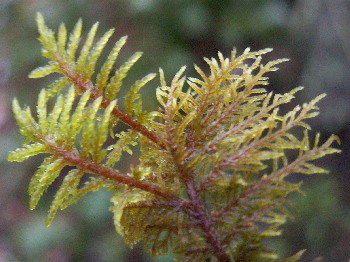 Stair-step moss, the most elaborate moss I've ever seen. The main fronds get up to 3-4cm long, and grow in long dangling chains. Picture this carpeting an area of several meters square.
Human-powered transport! I fell in love with biking and kayaking. I think the common thread is that they are both human-powered modes of transport that require a lot more thought than walking/running. I find them spectacularly engaging because I can pay attention to either the scenery or the vehicle, as I like. Plus, there's something satisfying about going twice or three times as fast as I could go unaided, but still without using a motor. I intend to continue both biking and kayaking in Boston -- I've borrowed a bike from a friend who's summering out of town, and apparently you can rent kayaks and go out on the Charles River.
Signing ghost! Yes, that said signing, not singing. We stopped in Ashland and caught a performance of Hamlet by the Oregon Shakespeare Festival, which was of course excellent. But one thing in particular struck me -- the ghost of Hamlet's father spoke in sign language! I looked through a couple of brochures and found out the ghost was played by Howie Seago, "the first deaf actor to play on OSF stages". I don't know any sign, so I couldn't tell whether he was using ASL or SEE or something else, but I thought it was a neat artistic choice to have him play the ghost, as opposed to a living character. (Hamlet spoke the ghost's lines, as if he only half-understood sign and was trying to keep up.) I bet translating Shakespeare into ASL is an interesting problem, too.
Monday, June 7, 2010
Wonder?
Christina Agapakis of Oscillator recently wrote a thought-provoking post about biosafety and synthetic biology. I was particularly struck by this passage:
I've often wondered myself why biology is so scary to so many people, and I think this is a particularly insightful way of putting it. If only more people would play around with sourdough starter or homemade yogurt, or manipulate soil pH to change the color of their hydrangeas, or hell just think harder about the fact that bacterial cells vastly outnumber human cells in a typical human body...
But of course, it's not that simple. Biology is hugely amazing or terrifying to a lot of people -- is there perhaps a good reason this is so? I feel like bio lab work has a really jading, mundanifying tendency: "I have the godlike power to manipulate the very genomes of bacteria!... and the result is that some of these spots are blue where none were blue before." The vast majority of the experiments I've personally done have ended either with a resounding "meh" or with a facepalm and a starting-over. Has this blinded me to the fact that, given sufficient equipment and time, I can engineer freaking life? How wondrous might genetic engineering seem to someone like Leeuwenhoek or Mendel?
What do y'all think? Especially you nonbiologists in the crowd? How weird does it seem to you that biologists collectively have these abilities? (And who's planning on seeing Splice?)
Why is biology scary to so many people? We've done a very good job of sterilizing our lives, separating ourselves from biology to the extant that when we think of the word bacteria we immediately think of infection that needs to be wiped out, not something that is part of our bodies, part of our everyday ecosystem that keeps us alive.
I've often wondered myself why biology is so scary to so many people, and I think this is a particularly insightful way of putting it. If only more people would play around with sourdough starter or homemade yogurt, or manipulate soil pH to change the color of their hydrangeas, or hell just think harder about the fact that bacterial cells vastly outnumber human cells in a typical human body...
But of course, it's not that simple. Biology is hugely amazing or terrifying to a lot of people -- is there perhaps a good reason this is so? I feel like bio lab work has a really jading, mundanifying tendency: "I have the godlike power to manipulate the very genomes of bacteria!... and the result is that some of these spots are blue where none were blue before." The vast majority of the experiments I've personally done have ended either with a resounding "meh" or with a facepalm and a starting-over. Has this blinded me to the fact that, given sufficient equipment and time, I can engineer freaking life? How wondrous might genetic engineering seem to someone like Leeuwenhoek or Mendel?
What do y'all think? Especially you nonbiologists in the crowd? How weird does it seem to you that biologists collectively have these abilities? (And who's planning on seeing Splice?)
Sunday, May 30, 2010
Reading the Histories of Middle-Earth
With characteristic good timing, I found myself suddenly interested in delving deeper into Tolkien's mythology... right around finals week. (Naturally, this led me to lie awake at night thinking about biological transport phenomena in the Two Trees of Valinor and so on.) But now I have a lot of free time and very little internet access, so I'm working my way through the first volume, The Book of Lost Tales I.
It takes a lot of getting used to. Everything's name is different, and the tales are interspersed with commentary from Christopher Tolkien, which is very insightful but detailed to the point of neuroticism. There are a number of subtle differences between this old material and the published Silmarillion, and very often I'm not sure which version I like better. (For example, in the Lost Tales, Ossë is a much more ambiguous character. He plays an important part in the story of the Lonely Isle, rather than just being "the Maia in charge of waves and storms".)
However, the big difference is that the whole history is framed as a series of tales told to a human mariner, Eriol, who comes to the Lonely Isle and hangs out with the Elves. And, well, it really doesn't work. Neither Eriol nor any of the tale-tellers is developed at all, although we are promised that actual plot events will happen later -- but they really need to happen closer to the beginning. The effect is basically "heroic adventurer arrives in distant mystical land and gets the Bible read to him for several weeks". It doesn't stand well on its own, but only in relation to LOTR, Hobbit, Silmarillion, etc. Let's just say I'm glad the stories were extensively revised before being published.
However, I'm only about halfway through the first history, and there are twelve, if I remember right. So I bet it gets interesting later. And after that, there's the Letters, where Tolkien gives a bunch more explicit commentary on the more philosophical ideas of his mythos -- mortality as Gift of Ilúvatar in particular. I'm looking forward to it!
It takes a lot of getting used to. Everything's name is different, and the tales are interspersed with commentary from Christopher Tolkien, which is very insightful but detailed to the point of neuroticism. There are a number of subtle differences between this old material and the published Silmarillion, and very often I'm not sure which version I like better. (For example, in the Lost Tales, Ossë is a much more ambiguous character. He plays an important part in the story of the Lonely Isle, rather than just being "the Maia in charge of waves and storms".)
However, the big difference is that the whole history is framed as a series of tales told to a human mariner, Eriol, who comes to the Lonely Isle and hangs out with the Elves. And, well, it really doesn't work. Neither Eriol nor any of the tale-tellers is developed at all, although we are promised that actual plot events will happen later -- but they really need to happen closer to the beginning. The effect is basically "heroic adventurer arrives in distant mystical land and gets the Bible read to him for several weeks". It doesn't stand well on its own, but only in relation to LOTR, Hobbit, Silmarillion, etc. Let's just say I'm glad the stories were extensively revised before being published.
However, I'm only about halfway through the first history, and there are twelve, if I remember right. So I bet it gets interesting later. And after that, there's the Letters, where Tolkien gives a bunch more explicit commentary on the more philosophical ideas of his mythos -- mortality as Gift of Ilúvatar in particular. I'm looking forward to it!
Thursday, May 20, 2010
Project idea: improving my attention span
By now it's a commonplace that the internet whittles your attention span down to the sort of tiny nub that only lets you focus on one thing for about thirty seconds before popping away to check email or RSS or Twitter or what have you. Word among my older MIT friends is that burnout and curricular exasperation can have similar effects. I'm inclined to believe them, having lost all patience with, say, biomechanics. *growl* *ahem* Where was I?
Oh, yes. I've been thinking that, among the other soul-restorative measures I plan to take this summer, I should work on reconstructing my attention span. According to my parents, when I was young I had a wonderful attention span, and could admire a pebble for ten minutes together. I'm not sure how much I believe them, but I do feel like my attention span has decreased dramatically over the past couple of years as I've started to read more and more things on the internet.
So I gave myself a test. I had to read something all the way through without looking at anything else on my computer. I picked the first interesting-looking article out of Give Me Something To Read, which turned out to be an NYTimes article about arranged remarriages in China following the 2008 Sichuan earthquake. (Incidentally, the article is very good -- thought-provoking and emotional without being overwrought.) Even though it was interesting, it was surprisingly difficult to get through. My mind kept wandering. Indeed, my mind is still wandering. I've pulled up my chat client once already while writing this blog post, and I keep having the urge to do it again. I'm like Randall Munroe at the typewriter here.
But with summer comes the opportunity to read books again! Do you have any idea how long it's been since I just sat down with a book and plowed more or less straight through the whole thing? I feel like I haven't done that since high school... So, as I pick up books again for the summer, I'll consciously practice keeping my attention on one thing for an extended period of time, and try to avoid get up every five minutes to get food or check my mail. We'll see how well I do, and whether this will translate to an improved studying efficiency in the fall.
Oh, yes. I've been thinking that, among the other soul-restorative measures I plan to take this summer, I should work on reconstructing my attention span. According to my parents, when I was young I had a wonderful attention span, and could admire a pebble for ten minutes together. I'm not sure how much I believe them, but I do feel like my attention span has decreased dramatically over the past couple of years as I've started to read more and more things on the internet.
So I gave myself a test. I had to read something all the way through without looking at anything else on my computer. I picked the first interesting-looking article out of Give Me Something To Read, which turned out to be an NYTimes article about arranged remarriages in China following the 2008 Sichuan earthquake. (Incidentally, the article is very good -- thought-provoking and emotional without being overwrought.) Even though it was interesting, it was surprisingly difficult to get through. My mind kept wandering. Indeed, my mind is still wandering. I've pulled up my chat client once already while writing this blog post, and I keep having the urge to do it again. I'm like Randall Munroe at the typewriter here.
But with summer comes the opportunity to read books again! Do you have any idea how long it's been since I just sat down with a book and plowed more or less straight through the whole thing? I feel like I haven't done that since high school... So, as I pick up books again for the summer, I'll consciously practice keeping my attention on one thing for an extended period of time, and try to avoid get up every five minutes to get food or check my mail. We'll see how well I do, and whether this will translate to an improved studying efficiency in the fall.
Subscribe to:
Posts (Atom)
