One of my favorite webcomics is Gunnerkrigg Court. It's a mixed fantasy, SF, and school story with some characters who are pretty badass for their apparent age (middle/high school). Antimony and Kat, the two main characters, play a crucial, growing role in trying to preserve peace and increase cooperation between their school (the Court) and the adjacent forest -- but they're also just two girls capering in a world that's often a lot bigger than they realize. It's framed as technology versus magic/divinity, but I have a feeling it runs a lot deeper than that.
I highly recommend reading it, even though it starts out just a little slow -- the 'real' threads start soon enough.
But why am I highlighting it now? I'm super excited, because in among all the magicians and mad roboticists, I think we may have our first mad biologist character.
Should I say that again? Mad. Biologist. Character.
Squee!
Err, I would totally include a small click-to-embiggen preview image of the comic, but I can't figure out how to make Blogger do that. I have been thinking of migrating to Wordpress...
Friday, July 30, 2010


Monday, July 19, 2010
But why is the sky blue?
Here's a sampling of the random questions I've encountered in the past week that have piqued my interest. I feel like these should be answerable with a little effort (by someone other than me, since my brain is stuck in corners), but they're also fun to just speculate about.
It's a commonplace that Benadryl makes you drowsy. kcr noted that it only seems to make him drowsy when it isn't busy fighting off an actual allergic reaction. Are the antihistamine and sleep-inducing activities of Benadryl different? Does one compete with the other?
Why do martial arts seem to be optimized for fighting other practitioners of that same martial art? I don't know anything about how martial arts develop, but my intuition says something like this: it's dangerous and impractical to always practice by getting in real fights, and if you're going to make a new variant on an existing style, then practicing against others of that style is a decent proxy for being in real fights. Of course, this runs into the bootstrapping problem of where did the first formalized martial art come from... but humans have been punching each other for so many years that I feel like basic instinct can serve as a starting point. (How do you go about designing a martial art for "real combat"? I know these exist -- mumble military mumble something.)
What's the most cost-effective way to make ice cream using a dry ice and ethanol bath?
It's a commonplace that Benadryl makes you drowsy. kcr noted that it only seems to make him drowsy when it isn't busy fighting off an actual allergic reaction. Are the antihistamine and sleep-inducing activities of Benadryl different? Does one compete with the other?
Why do martial arts seem to be optimized for fighting other practitioners of that same martial art? I don't know anything about how martial arts develop, but my intuition says something like this: it's dangerous and impractical to always practice by getting in real fights, and if you're going to make a new variant on an existing style, then practicing against others of that style is a decent proxy for being in real fights. Of course, this runs into the bootstrapping problem of where did the first formalized martial art come from... but humans have been punching each other for so many years that I feel like basic instinct can serve as a starting point. (How do you go about designing a martial art for "real combat"? I know these exist -- mumble military mumble something.)
What's the most cost-effective way to make ice cream using a dry ice and ethanol bath?
Monday, July 12, 2010
A sure sign of a healthy lab
Whiteboard, day 1:
Whiteboard, day 2:
Paper attached to whiteboard, day 3:
Oh Danny boy, pipets, pipets are calling,
From bench to bench, and in the TC hood.
The gels are gone, and all the yields are falling;
'Tis you, 'tis you must make the data good.
So come ye back, where we cells are abiding,
Or when the lab is lonely as the grave.
'Tis here we'll be, in log-phase swift dividing...
...if you will please not put us in the autoclave!
THURS 3:30
GROUP MEETING
DANNY
GROUP MEETING
DANNY
Whiteboard, day 2:
THURS 3:30
GROUP MEETING
Oh DANNY boy
GROUP MEETING
Oh DANNY boy
Paper attached to whiteboard, day 3:
Oh Danny boy, pipets, pipets are calling,
From bench to bench, and in the TC hood.
The gels are gone, and all the yields are falling;
'Tis you, 'tis you must make the data good.
So come ye back, where we cells are abiding,
Or when the lab is lonely as the grave.
'Tis here we'll be, in log-phase swift dividing...
...if you will please not put us in the autoclave!
Friday, July 2, 2010
Bacteria break symmetry too
It's amazing what you can learn on the internet, especially when looking for something totally unrelated! :)
Caulobacter crescentus is a really cool little bacterial species with a funky two-phase lifestyle. The "stalked cells" attach themselves to rocks or whatever in the freshwater environments where these guys live. When a stalked cell divides, part of it remains a stalked cell and part splits off into a "swarmer cell". The swarmer cells swim around like more 'normal' bacteria.
Check out some images of these dudes. (Blogger's image uploader is misbehaving so you guys get a link to Google Images. Sigh.)
They're a fascinating organism to study because their cell division is asymmetrical. If you think back to the high-school-biology version of mitosis... well, it seems like a totally symmetrical process, right? There would seem to be no reason for a particular set of molecules to end up in one daughter cell and not the other, because everything's floating freely around in a droplet of water anyway. But in an asymmetric division like this, the two daughter cells have to develop in different ways. The stalked cell has to keep maintaining its stalk, but the swarmer cell has to grow a flagellum and start making the necessary sensory proteins to swim toward yummy-smelling food molecules. And not only that, but there's a correct orientation for this difference and an incorrect one. It would be kind of awkward if the new stalked cell started trying to swim away, and the swarmer cell floated around trying vainly to anchor to something.
So there must be some sophisticated mechanisms at play here. Notably, it's not that the two daughter cells end up with different genes -- after all, the swarmer cell will later settle and put down roots as a stalked cell. What matters is the presence (or absence) of proteins and other molecules that regulate those genes, so the stalked cell can keep making stalk proteins while the swimmer turns those genes off and turns on the ones for making a flagellum.
This asymmetric division isn't just some strange bacterial phenomenon. Every multicellular creature goes through this kind of process as it grows from a single cell (a fertilized egg) to whatever elaborate body it has as an adult. Figuring out the origins of symmetry-breaking in cell division is one of the major problems of developmental biology.
It also has to do with stem cells, by definition. The vast majority of cells in your body are "terminally differentiated" -- that is, they've gone from nondescript round blobs to fully elaborated cells with sophisticated morphology, heavily optimized for doing whatever job it is they need to do. But the 'terminally' part means they stop dividing once they reach maturity. So if you lose some mature cells, you need to get new ones from a renewable pool of immature cells. These are stem cells. The key defining feature of a stem cell is that it can divide asymmetrically. One of its progeny will be a precursor cell, traveling inexorably down the path to neuron-hood or white-blood-cell-hood or whatever. The other will be a new stem cell, all set to keep hanging in the lazy infinite loop of waiting until it's needed again.
Caulobacter crescentus is a really cool little bacterial species with a funky two-phase lifestyle. The "stalked cells" attach themselves to rocks or whatever in the freshwater environments where these guys live. When a stalked cell divides, part of it remains a stalked cell and part splits off into a "swarmer cell". The swarmer cells swim around like more 'normal' bacteria.
Check out some images of these dudes. (Blogger's image uploader is misbehaving so you guys get a link to Google Images. Sigh.)
They're a fascinating organism to study because their cell division is asymmetrical. If you think back to the high-school-biology version of mitosis... well, it seems like a totally symmetrical process, right? There would seem to be no reason for a particular set of molecules to end up in one daughter cell and not the other, because everything's floating freely around in a droplet of water anyway. But in an asymmetric division like this, the two daughter cells have to develop in different ways. The stalked cell has to keep maintaining its stalk, but the swarmer cell has to grow a flagellum and start making the necessary sensory proteins to swim toward yummy-smelling food molecules. And not only that, but there's a correct orientation for this difference and an incorrect one. It would be kind of awkward if the new stalked cell started trying to swim away, and the swarmer cell floated around trying vainly to anchor to something.
So there must be some sophisticated mechanisms at play here. Notably, it's not that the two daughter cells end up with different genes -- after all, the swarmer cell will later settle and put down roots as a stalked cell. What matters is the presence (or absence) of proteins and other molecules that regulate those genes, so the stalked cell can keep making stalk proteins while the swimmer turns those genes off and turns on the ones for making a flagellum.
This asymmetric division isn't just some strange bacterial phenomenon. Every multicellular creature goes through this kind of process as it grows from a single cell (a fertilized egg) to whatever elaborate body it has as an adult. Figuring out the origins of symmetry-breaking in cell division is one of the major problems of developmental biology.
It also has to do with stem cells, by definition. The vast majority of cells in your body are "terminally differentiated" -- that is, they've gone from nondescript round blobs to fully elaborated cells with sophisticated morphology, heavily optimized for doing whatever job it is they need to do. But the 'terminally' part means they stop dividing once they reach maturity. So if you lose some mature cells, you need to get new ones from a renewable pool of immature cells. These are stem cells. The key defining feature of a stem cell is that it can divide asymmetrically. One of its progeny will be a precursor cell, traveling inexorably down the path to neuron-hood or white-blood-cell-hood or whatever. The other will be a new stem cell, all set to keep hanging in the lazy infinite loop of waiting until it's needed again.
Thursday, June 24, 2010
Life lessons for synthetic biologists
1. A serious lesson
"Biology may or may not care about the physicist's insatiable desire for elegance." -- Jeff Hasty
 Figure 1: In other words, sometimes this happens. From Hasty et al, Physical Review Letters 2002 | doi:10.1103/PhysRevLett.88.148101
2. Another lesson that is just as serious
Humor in lab is essential, of course. However, if you just heard the great story about the giant biohazard bag full of innocuous things in your PI's car... finish laughing before you load your gel.
 The idea, of course, is to prevent this from happening. [Original photo source]
"Biology may or may not care about the physicist's insatiable desire for elegance." -- Jeff Hasty
 Figure 1: In other words, sometimes this happens. From Hasty et al, Physical Review Letters 2002 | doi:10.1103/PhysRevLett.88.148101
2. Another lesson that is just as serious
Humor in lab is essential, of course. However, if you just heard the great story about the giant biohazard bag full of innocuous things in your PI's car... finish laughing before you load your gel.
 The idea, of course, is to prevent this from happening. [Original photo source]
Sunday, June 13, 2010
MOSS!
I'm back from a 2.5-week family jaunt to Oregon and Washington. We bummed around a lot of national parks and did a wide variety of Wilderness Things. Here are some of the highlights:
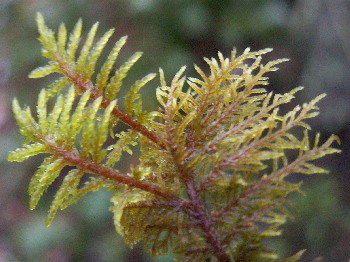
Moss! We did go whale-watching, but for some reason I just don't get that excited about the large wildlife. I like to look at little things. And it turns out, the temperate rain forest is basically an ideal environment for dozens of moss species to thrive, reaching epic heights of lushness that I never dreamed of, growing up with miles of chaparral on all sides. There's lichens and liverworts too, but for some reason the mosses appeal to me the most. I discovered the macro setting on my camera (!) and took loads of pictures, trying to document as many different species as I could... but then I sat down too quickly on a rock and destroyed the screen. Argh! So I had to stop taking pictures. I don't even have the memory card with me, because my dad took it out when we got home and forgot to give it back to me before I flew back to Boston. So rest assured, I'll post my photos eventually. For now, here's a teaser photo taken by Derrick Ditchburn, who is a far better photographer than I. (More lovely moss photos at Dereila Images (do click on "More Moss" at the bottom).)
 Stair-step moss, the most elaborate moss I've ever seen. The main fronds get up to 3-4cm long, and grow in long dangling chains. Picture this carpeting an area of several meters square.
Human-powered transport! I fell in love with biking and kayaking. I think the common thread is that they are both human-powered modes of transport that require a lot more thought than walking/running. I find them spectacularly engaging because I can pay attention to either the scenery or the vehicle, as I like. Plus, there's something satisfying about going twice or three times as fast as I could go unaided, but still without using a motor. I intend to continue both biking and kayaking in Boston -- I've borrowed a bike from a friend who's summering out of town, and apparently you can rent kayaks and go out on the Charles River.
Signing ghost! Yes, that said signing, not singing. We stopped in Ashland and caught a performance of Hamlet by the Oregon Shakespeare Festival, which was of course excellent. But one thing in particular struck me -- the ghost of Hamlet's father spoke in sign language! I looked through a couple of brochures and found out the ghost was played by Howie Seago, "the first deaf actor to play on OSF stages". I don't know any sign, so I couldn't tell whether he was using ASL or SEE or something else, but I thought it was a neat artistic choice to have him play the ghost, as opposed to a living character. (Hamlet spoke the ghost's lines, as if he only half-understood sign and was trying to keep up.) I bet translating Shakespeare into ASL is an interesting problem, too.
Moss! We did go whale-watching, but for some reason I just don't get that excited about the large wildlife. I like to look at little things. And it turns out, the temperate rain forest is basically an ideal environment for dozens of moss species to thrive, reaching epic heights of lushness that I never dreamed of, growing up with miles of chaparral on all sides. There's lichens and liverworts too, but for some reason the mosses appeal to me the most. I discovered the macro setting on my camera (!) and took loads of pictures, trying to document as many different species as I could... but then I sat down too quickly on a rock and destroyed the screen. Argh! So I had to stop taking pictures. I don't even have the memory card with me, because my dad took it out when we got home and forgot to give it back to me before I flew back to Boston. So rest assured, I'll post my photos eventually. For now, here's a teaser photo taken by Derrick Ditchburn, who is a far better photographer than I. (More lovely moss photos at Dereila Images (do click on "More Moss" at the bottom).)
 Stair-step moss, the most elaborate moss I've ever seen. The main fronds get up to 3-4cm long, and grow in long dangling chains. Picture this carpeting an area of several meters square.
Human-powered transport! I fell in love with biking and kayaking. I think the common thread is that they are both human-powered modes of transport that require a lot more thought than walking/running. I find them spectacularly engaging because I can pay attention to either the scenery or the vehicle, as I like. Plus, there's something satisfying about going twice or three times as fast as I could go unaided, but still without using a motor. I intend to continue both biking and kayaking in Boston -- I've borrowed a bike from a friend who's summering out of town, and apparently you can rent kayaks and go out on the Charles River.
Signing ghost! Yes, that said signing, not singing. We stopped in Ashland and caught a performance of Hamlet by the Oregon Shakespeare Festival, which was of course excellent. But one thing in particular struck me -- the ghost of Hamlet's father spoke in sign language! I looked through a couple of brochures and found out the ghost was played by Howie Seago, "the first deaf actor to play on OSF stages". I don't know any sign, so I couldn't tell whether he was using ASL or SEE or something else, but I thought it was a neat artistic choice to have him play the ghost, as opposed to a living character. (Hamlet spoke the ghost's lines, as if he only half-understood sign and was trying to keep up.) I bet translating Shakespeare into ASL is an interesting problem, too.
Monday, June 7, 2010
Wonder?
Christina Agapakis of Oscillator recently wrote a thought-provoking post about biosafety and synthetic biology. I was particularly struck by this passage:
I've often wondered myself why biology is so scary to so many people, and I think this is a particularly insightful way of putting it. If only more people would play around with sourdough starter or homemade yogurt, or manipulate soil pH to change the color of their hydrangeas, or hell just think harder about the fact that bacterial cells vastly outnumber human cells in a typical human body...
But of course, it's not that simple. Biology is hugely amazing or terrifying to a lot of people -- is there perhaps a good reason this is so? I feel like bio lab work has a really jading, mundanifying tendency: "I have the godlike power to manipulate the very genomes of bacteria!... and the result is that some of these spots are blue where none were blue before." The vast majority of the experiments I've personally done have ended either with a resounding "meh" or with a facepalm and a starting-over. Has this blinded me to the fact that, given sufficient equipment and time, I can engineer freaking life? How wondrous might genetic engineering seem to someone like Leeuwenhoek or Mendel?
What do y'all think? Especially you nonbiologists in the crowd? How weird does it seem to you that biologists collectively have these abilities? (And who's planning on seeing Splice?)
Why is biology scary to so many people? We've done a very good job of sterilizing our lives, separating ourselves from biology to the extant that when we think of the word bacteria we immediately think of infection that needs to be wiped out, not something that is part of our bodies, part of our everyday ecosystem that keeps us alive.
I've often wondered myself why biology is so scary to so many people, and I think this is a particularly insightful way of putting it. If only more people would play around with sourdough starter or homemade yogurt, or manipulate soil pH to change the color of their hydrangeas, or hell just think harder about the fact that bacterial cells vastly outnumber human cells in a typical human body...
But of course, it's not that simple. Biology is hugely amazing or terrifying to a lot of people -- is there perhaps a good reason this is so? I feel like bio lab work has a really jading, mundanifying tendency: "I have the godlike power to manipulate the very genomes of bacteria!... and the result is that some of these spots are blue where none were blue before." The vast majority of the experiments I've personally done have ended either with a resounding "meh" or with a facepalm and a starting-over. Has this blinded me to the fact that, given sufficient equipment and time, I can engineer freaking life? How wondrous might genetic engineering seem to someone like Leeuwenhoek or Mendel?
What do y'all think? Especially you nonbiologists in the crowd? How weird does it seem to you that biologists collectively have these abilities? (And who's planning on seeing Splice?)
Subscribe to:
Posts (Atom)
